

94%
Tasks AI-Capable
30%
Actual AI usage
64pt
The adoption gap
$8.5T
Revenue at risk by 2030
The wave is here. AI Bootcamps are emerging as the most direct answer to a question that has stalled enterprise AI for three years: how do you move from access to adoption? Not through another training module. Not through another strategy deck. Through hands-on, task-level workflow transformation, the kind that produces a project-ready team in 14 days. AI Bootcamps for enterprises are gaining traction precisely because they don’t start with tools. They start with the work itself auditing every workflow, classifying every task, and rebuilding how people operate alongside AI.
At Nuvepro, the approach is built on a foundation called Task Intelligence– a structured methodology that classifies every task across a workflow into three categories: what AI should own fully, what humans and AI do together, and what stays irreducibly human. This task-level precision is what makes Nuvepro’s AI Bootcamps different: teams don’t just learn about AI- they build live workflows, stress-test handoffs, and prove readiness through independent assessments. The goal is operational readiness, not certification theater, but a workforce that can operate the new model from day one.
The outcome isn’t a trained workforce. It’s an agentic organisation: one where humans define the judgment calls, and AI agents handle the execution. Nuvepro’s AI Bootcamps for enterprises are the fastest path from adoption gap to agentic enterprise, combining Task Intelligence architecture, GenAI Sandbox simulations, and rigorous operational readiness assessment into a sprint your team completes in 14 days. The rest of this piece explains why that gap exists, and why conventional approaches keep failing to close it.
Enterprises aren’t short on AI investments today. The tools are deployed, access is widespread, and leadership has made its intent clear. Yet, actual usage data continues to reveal a very different reality.
You will find employees toggling between tabs, rewriting emails, pulling data from scattered systems, sitting through repetitive workflows while, just a few clicks away, AI tools promise to do most of it faster, smarter, and at scale. The capability is there. The access, in many cases, is already paid for. And yet, the way work happens hasn’t fundamentally shifted.
Having spent time closely observing enterprise environments, one pattern keeps surfacing. Organizations invest in enterprise AI training programs, introduce new tools, even encourage experimentation but the change rarely sticks. Initial excitement fades. Usage becomes inconsistent. And what started as a transformation initiative quietly settles into occasional, surface-level adoption.
It’s not because the tools don’t work. It’s not because people aren’t interested. It’s because somewhere between introduction and integration, something breaks.
What makes this moment different from every previous wave of enterprise technology is the scale of what’s at stake. This isn’t about marginal gains or incremental efficiency. Research from McKinsey & Company and Anthropic suggests that AI systems today can handle up to 94% of tasks in certain knowledge-work roles. At the same time, organizations are investing in generative AI training for employees to prepare for this shift.
That’s not just another upgrade cycle. That’s a complete redefinition of how work itself gets done.
The 64-Point Gap Nobody Wants to Talk About
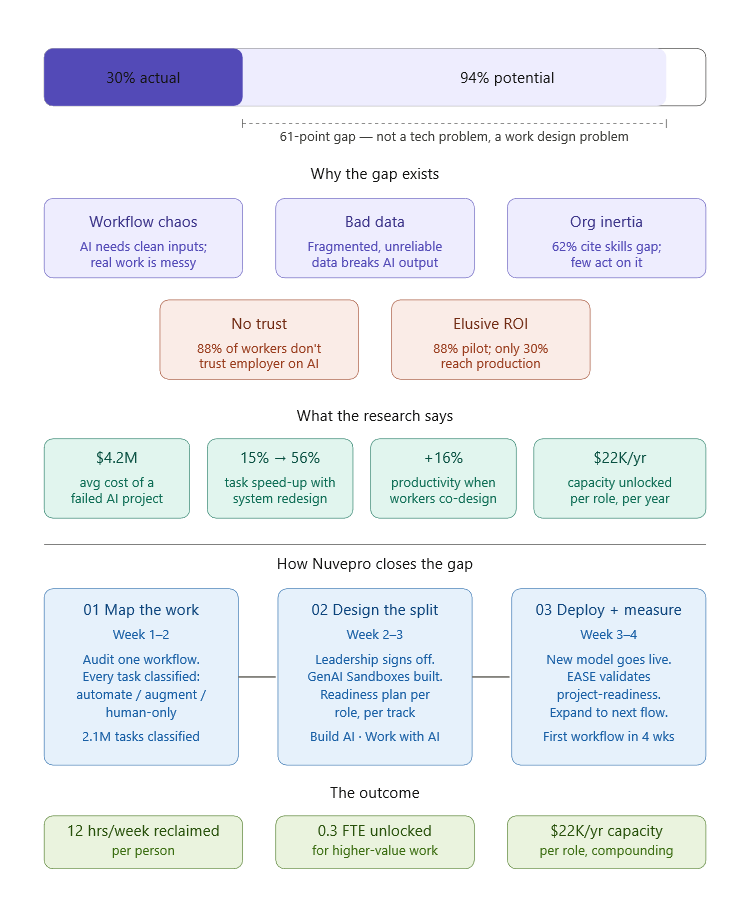
The difference between what AI can do and what enterprises are actually doing with it has a name now: the Adoption Gap. Researchers at Anthropic and McKinsey have put numbers to it - AI is capable of handling upwards of 94% of tasks in roles like data analysis, legal review, customer service, and software development. Actual usage across the enterprise sits somewhere around 30%.
The 64-percentage-point gap between AI’s potential (94% of tasks in certain roles) and actual usage (~30%) is being called the “Adoption Gap.” According to research from Anthropic and McKinsey, this disparity isn’t a failure of technology – modern models are already capable of the work. Instead, the lag is caused by “deployment friction”: the practical, legal, and organizational hurdles of moving from a chatbot to an integrated business system.
“The tools work fine. Your workforce wasn’t redesigned to use them.”
Nobody has really onboarded AI yet. No clear access, no defined playbooks, no clarity on where it fits into everyday work. It’s like having an incredibly capable expert walk into the organization and then leaving them idle, waiting for direction. The potential is obvious, but without structure, even the most powerful capability ends up underutilized.
Four Friction Points Keeping Enterprises Stuck
When you dig into why the gap persists, four patterns emerge - each one distinct, each one reinforcing the others.
01
The Tacit Knowledge Problem
Most business processes aren’t documented anywhere. They live in people’s heads, shaped by years of institutional memory, personal relationships, and unwritten rules. AI struggles with this kind of messy, context-dependent decision-making, not because it’s incapable, but because nobody has taken the time to translate tacit knowledge into something it can work with. Companies bolt AI onto old processes instead of redesigning the work from scratch.
02
Legal and Risk Constraints
Highly regulated industries – law, finance, healthcare face real data residency and confidentiality requirements that slow everything down. Management has adopted a “pause-and-fix” posture after discovering that 66% of employees admit to using AI outputs without validation. And nobody has settled the liability question: who is legally responsible when an autonomous agent makes a million-dollar mistake?
03
Data Readiness
AI needs clean, accessible, well-structured data. Most enterprises don’t have it. Information is trapped in fragmented legacy systems that don’t talk to each other. According to Infosys research, 64% of leaders cite poor data quality as their single biggest barrier. AI running on messy data doesn’t just underperform – it hallucinates, which erodes trust faster than almost anything else.
04
The Human Factor
High-anxiety employees will comply with AI mandates on paper while protecting their actual workflows from real change. 50% of businesses report a skills gap severe enough that they can’t find the talent to build and maintain these systems internally. This isn’t laziness – it’s a predictable response to change that was announced but never properly supported.
None of these are technology problems. They’re organizational problems. And they’re the kind that a new model release, a better prompt library, or a fancier dashboard won’t fix.
Why Traditional Training Doesn’t Move the Needle
The first instinct when adoption lags is to run training. And for the last two years, enterprises have run a lot of training - workshops, e-learning modules, generative AI training for employees, prompt engineering courses. Some of it is genuinely valuable. Most of it produces a post-training survey full of green scores and zero lasting behavior change.
The problem is that generic AI literacy, delivered in a classroom or a learning management system, doesn’t close the gap between capability and usage. What it teaches is that AI exists and that it can, in theory, help you. What it doesn’t teach is: here is your specific role, here are the specific tasks within it that AI should now handle, here is how the handoff between you and the agent works, and here is how we’ll know if you’re doing it correctly.
“Learning without hands-on practice in realistic environments isn’t learning.” – Janardhan Santhanam, Global Head of Talent Development, TCS
This is why AI training for non-technical employees – the majority of any enterprise workforce has to be fundamentally different from anything that came before it. It can’t start with the technology. It has to start with the work: what tasks does this person actually do, which of those can AI now own, which require human-AI collaboration, and which remain entirely human? Only once you’ve answered those questions does training have something real to train people on.
The other thing that’s missing from most enterprise AI training programs is validation. Completing a module is not evidence of readiness. What organizations actually need is AI-powered skill assessment – the ability to evaluate whether someone can actually operate in the new working model, not just describe it. AI-driven skill evaluation that maps to real job tasks, in realistic environments, with measurable outputs. That’s the missing layer between training and transformation.
The Task-Level Audit: A Different Starting Point
What’s becoming clear, through actual deployment experience rather than theory, is that the organizations closing the adoption gap are doing something different at the start. They’re not beginning with the technology. They’re beginning with the work.
Specifically, they are auditing every workflow and every role at the task level cataloguing what people actually do, then classifying each task: what AI should own entirely, what humans and AI do together, and what stays human. This sounds simple. It isn’t. It requires understanding business processes at a level of granularity that most organizations have never needed before, combined with a deep understanding of what current AI systems can and can’t reliably do.
But the organizations that do this work first find that everything downstream becomes clearer. The training has something specific to point at. The change management has a concrete story to tell – this is what your job looks like now, this is what the agent handles, this is where your judgment still matters. The AI-powered assessments can actually test the right things. And the ROI calculation stops being a forecast and starts being real numbers from redesigned workflows.
According to Anthropic’s own research published in 2026, 30% of workers currently have zero AI task coverage meaning their workflows have not been redesigned at all, despite their organizations having purchased and deployed AI tools. The tools are in the building. The work hasn’t changed.
The gap isn’t going to close by itself. Every quarter spent waiting is another quarter where tool spend grows and productivity doesn’t.
What Closing the Gap Actually Looks Like
At a practical level, the enterprises that are moving the needle share a few characteristics. They’ve stopped treating AI adoption as an IT deployment problem and started treating it as a workforce redesign problem. They’ve defined what “AI-ready” looks like for each role, not just for the organization in the abstract. And they’ve built the infrastructure for ongoing AI-powered talent evaluation because the answer to “are your people ready?” can’t be a one-time assessment. It has to be continuous.
They have also recognized that the population most in need of support isn’t the technical team. It’s the finance managers, the HR generalists, the customer success reps, the legal associates – the business professionals who make up the vast majority of the workforce and whose jobs are changing fastest. AI for business professionals that’s specific to their actual tasks, delivered in environments that mirror their real workflows, and validated with AI-based skill evaluation that produces evidence of competency rather than just course completions.
The organizations that get this right end up with something genuinely different: not just employees who know AI exists, but employees who know exactly which parts of their job they’re now supervising rather than doing, and who have practiced that supervision in realistic conditions until it’s habit.
How Nuvepro Is Enabling This
Task Intelligence for the Enterprise
Nuvepro works directly on the adoption gap starting not with training, but with the work itself. The platform classifies every task across your workflows and roles: what AI should own, what humans and AI do together, and what stays human. Then it gets your people ready to operate the new model.
For the two populations that matter most – those who build and run agents, and those who supervise and collaborate with them – Nuvepro delivers:
- Task-level workflow audit across 81 industries
- AI sandbox training platform with real-world, sandboxed environments
- AI training with hands-on labs for enterprises across technical and business roles
- Separate readiness tracks for technical and non-technical roles
- EASE certifications: AI-powered assessments that validate project-readiness
- Real-time AI-driven skill evaluation mapped to actual job tasks
- First workflow live in 4 weeks
Several large enterprises have leveraged Nuvepro’s approach to clearly identify workforce skill gaps, enable scalable learning in real-world environments, and translate that into measurable business impact. The results have been consistent- around 12 hours saved per employee every week, close to 0.3 FTE capacity unlocked per role, and a meaningful shift of time and effort toward more strategic, high-value work.
The audit starts the process. From there, the platform handles enterprise AI training programs for both tracks – those building agents and those working alongside them backed by AI-powered talent evaluation that produces evidence, not assumptions.
The Cost of Waiting
The 64-point adoption gap is not a temporary condition that will resolve on its own as AI gets better. If anything, it tends to widen because organizations that haven’t redesigned their workflows aren’t just falling behind on productivity; they’re accumulating a kind of organizational debt. The longer the work goes unredesigned, the more entrenched the old habits become, the more the tool spend piles up without returns, and the harder the eventual change becomes.
Korn Ferry estimates $8.5 trillion in unrealized revenue by 2030 attributable to talent shortages including the shortage of people who know how to actually work with AI. That number is large enough to be abstract. The practical version is simpler: your competitors who figure this out six months before you do will have a workforce that’s operating at a fundamentally different level of capacity. Not because they have better models. Because they did the organizational work yours hasn’t done yet.
The AI is ready. The question and it has always been the question is whether the organization around it is.
Nuvepro’s Task Intelligence platform enables enterprises to break down and analyze how work actually gets done, reimagine workflows around AI, and build a workforce that’s truly project-ready- not just trained. With a structured, hands-on approach, organizations can move from insight to execution quickly, often seeing their first redesigned workflow go live within weeks. Explore more at www.nuvepro.ai