

Everyone is deploying AI. Very few organizations know which specific tasks it should touch. That gap between AI spend and AI outcomes is exactly what Task Intelligence closes.
There is a question most organizations cannot answer not because the data doesn’t exist, but because nobody has asked it at the right level of granularity: Which specific tasks in your key roles should AI handle, which should a human and AI do together, and which should stay entirely human?
You may know how many people you have. You may know their job titles, their skills, even their performance ratings. But if you don’t know which tasks they perform daily, how much time each task takes, and how AI capability maps onto each one, you don’t have the information you need to make AI work.
That’s the problem Task Intelligence solves. And it’s why Nuvepro’s Task Intelligence Platform has become the starting point for every serious enterprise AI transformation.
What is Task Intelligence?
Task Intelligence is the systematic classification of every task in a job role or workflow as automate, augment, or human-only. It is the data layer that turns AI tool spend into measurable productivity. Without it, organizations have AI tools deployed to job titles. With it, they have an AI-enabled workforce and a precise map of exactly where the productivity comes from.
Think of it as a diagnostic before the prescription. Most AI initiatives skip the diagnostic entirely. They buy the tool, run a training program, and then measure whether productivity improved. Task Intelligence reverses that sequence: classify first, deploy second, train third. The sequence is everything.
The intellectual foundation of Task Intelligence is not a new idea. Frey and Osborne established in 2013 that automation analysis must happen at the task level, not the job level. Acemoglu and Restrepo (2016–2024) built the formal economic model showing that technology automates tasks, augments tasks, or creates new ones. Dell’Acqua et al. (Harvard/BCG, 2023) proved through a controlled experiment that classification before deployment is essential. Nuvepro operationalizes two decades of that research at enterprise scale.
“Job titles lie. Tasks tell the truth. A ‘Financial Analyst’ at one company does 35 tasks. At another, the same title covers 22 completely different ones. AI doesn’t affect titles, it affects tasks.”
Why does Task Intelligence matter now?
Here is what most AI transformations get wrong from day one: they treat workflows as the thing AI will replace.
AI adoption is real. According to a16z (2026), 29% of Fortune 500 companies are live, paying AI customers, a penetration rate achieved in just 3.5 years. Eighty percent of workers have at least 10% of their tasks exposed to large language models (Eloundou et al., 2024).
But exposure is not transformation. And tool access is not productivity.
The Harvard/BCG Jagged Frontier study showed what happens when AI is deployed without task-level mapping: consultants using AI on tasks inside AI’s capability frontier improved performance by 12–40%. On tasks outside the frontier, they performed 19 percentage points worse than their unaided baseline. The upside and the downside are roughly equal in magnitude. Without Task Intelligence, organizations don’t know which tasks fall on which side and can easily end up net negative.
29%
Of Fortune 500 are live AI customers (a16z, 2026)
80%
Of workers have 10%+ tasks exposed to LLMs (Eloundou et al., 2024)
1.9x
Revenue for startups that mapped tasks before deploying AI (Kim, INSEAD 2026 RCT)
The organizations seeing real outcomes share one habit: they classify before they deploy. Kim’s randomized controlled trial across 515 startups (INSEAD, 2026) found that structured task mapping before AI deployment produced 1.9x revenue improvement. Tool access alone without the mapping produced no significant difference.
This is why Nuvepro’s Task Intelligence Platform exists. Not as a training catalog or a skills assessment. As a task-level classification engine that tells you before any tool is deployed or any training is built exactly which work should change and which should not.
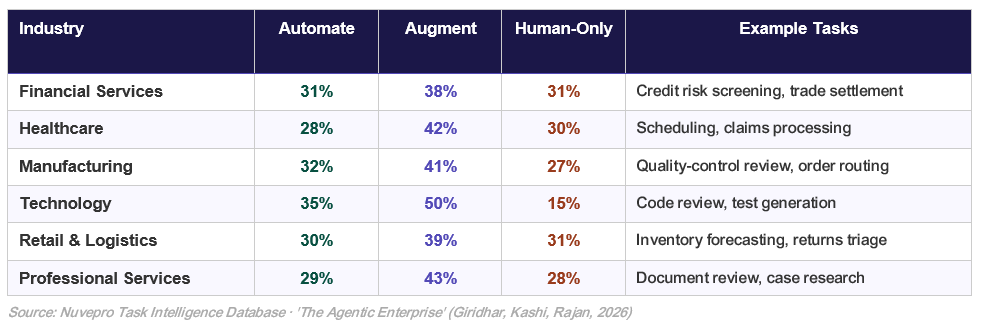
The 30/40/30 pattern - what 2.1 million tasks reveal
When Nuvepro's Task Intelligence Platform classified 2,143,500 tasks across six industries, 60 occupational roles, and 11 companies, a consistent pattern emerged. This was first documented in The Agentic Enterprise (Giridhar, Kashi, Rajan, 2026) and has held with remarkable stability across every industry examined since.
30%
AUTOMATE
AI handles end-to-end. Invoice processing, data entry, scheduling, routine reporting. Deploy AI agents here first.
40%
AUGMENT
Human + AI together. The largest bucket – and where most productivity value lives. AI does 70-80%; humans provide judgment and accountability.
30%
HUMAN ONLY
Empathy, negotiation, ethical reasoning, creative synthesis, physical presence. Protect and invest in this work.
The aggregate pattern is a useful frame, but it hides dramatic variation at the role level. A bookkeeping clerk scores 78% AI readiness. A nursing assistant scores 16%. That is a 62-point gap within the same economy, the same labor market, the same 2026. The future of work is not uniform. It arrives in role-specific chunks. Nuvepro’s Task Intelligence Platform is how you map your specific terrain.
How Nuvepro's Task Intelligence Platform works
Nuvepro's Task Intelligence Platform operates in five steps from workflow documentation to a live, AI-enabled workforce. The full cycle takes 14 days from zero to your team's first AI-enabled task in production.
01 Document the workflows
Start with how work actually flows, not how the org chart says it should. Map end-to-end processes like Procure-to-Pay, Order-to-Cash, and Incident Resolution so every task has a workflow context. Nuvepro has indexed 10,000+ workflows from APQC, SaaS platforms, and AI vendors.
02 Decompose every role into tasks
A job title is too coarse for AI planning. Nuvepro’s Task Intelligence Platform breaks each role into 15–40 discrete tasks using 8 parallel data sources including U.S. Department of Labor occupational data, real job postings from 2,400+ companies, APQC workflow databases, and audit history from previous engagements.
03 Classify each task
Every task is classified as automate, augment, or human-only across two tiers: Tier 1 (today’s publicly available AI) and Tier 3 (enterprise AI with company-specific data and fine-tuned models). This lets organizations plan for both current capability and the direction the frontier is moving.
04 Redesign the workflow
With the classification complete, the operating model changes. Automatable tasks get AI agents. Augmented tasks get defined human-AI handoffs. Human-only tasks get protected. The workflow is rebuilt from the task level up, not from the org chart down.
05 Ready the workforce through AI Bootcamps and Nuvepro Hands-on Labs
Two training tracks: Work with AI (supervision, validation, quality control) and Build with AI (configure, connect, create workflows). Delivered in Nuvepro Hands-on Labs GenAI Sandboxes that mirror employees’ actual production environment. This is not slide-deck training. It is task-specific, role-specific practice that builds muscle memory for human-AI collaboration. AI Bootcamps are available for teams moving through multiple workflow areas in parallel, compressing the transformation timeline significantly.
WHY 14 DAYS?
The timeline is achievable because Nuvepro’s 2.1 million pre-classified tasks mean you are not starting from scratch. You are applying a validated framework, built on two decades of labor economics research, to your specific context. The heavy analytical lifting is already done.
What makes Nuvepro's Task Intelligence Platform different
Several vendors use the phrase 'task intelligence.' They mean different things. TechWolf infers skills from work artifacts. ServiceNow routes IT tickets. Beamery matches people to roles. Nuvepro's Task Intelligence Platform classifies every task in a role or workflow to redesign how work gets done. The unit of analysis, the question answered, and the output are fundamentally different.
Most critically: Nuvepro’s Task Intelligence Platform does not start with courses. It starts with the work itself. Before a single training module is delivered, every task is classified using frameworks rooted in 20 years of labor economics research – O*NET, APQC, SFIA. The enterprise AI training programs that follow are built around those classified tasks. Employees train in Nuvepro Hands-on Labs on the exact tasks that changed and learn what to do differently on the job, not just what AI is.
THE KEY DISTINCTION
Skills intelligence tells you someone lacks ‘prompt engineering.’ Task Intelligence tells you that 12 of their 30 daily tasks can be automated, 14 should be augmented, and 4 stay human. Task classification determines which skills matter – not the other way around. Building enterprise AI training programs without first classifying tasks is solving a problem you haven’t yet diagnosed.
The benefits of Task Intelligence - three measurable outcomes
Task Intelligence produces three outcomes that appear on the balance sheet, not just in a training completion report.
1. Workflow reimagined
Every task classified. AI agents assigned to automatable work. Humans assigned to judgment, creativity, and oversight. Handoffs defined. The operating model rebuilt from the task level up. Peer-reviewed result: 25% faster task completion (Dell’Acqua et al., Harvard/BCG, 2023).
2. Workforce reimagined
Employees who train on their specific changed tasks in Nuvepro Hands-on Labs and AI Bootcamps don’t just understand AI in the abstract. They build the exact human-AI collaboration habits the redesigned workflow requires. Federal Reserve data shows AI users save 2.2 hours per person per week. Noy and Zhang (MIT, 2023) found 40%-time savings and 18% quality improvement when professionals practiced on their actual tasks.
3. Balance sheet reimagined
Dollar impact per person, calculated using Bureau of Labor Statistics occupation-specific wage data. Team scale projections. Board-ready numbers that tie AI investment to productivity outcomes not vendor projections. Defensible, role-level calculations that survive CFO scrutiny.
Task Intelligence and the path to becoming an agentic organisation
Task Intelligence is not just a workforce planning tool. It is the foundation of becoming an agentic organisation, one where AI agents handle automatable work, humans and AI collaborate on augmented work, and humans are protected and elevated in the tasks that require uniquely human capability.
An agentic organisation is not built by deploying AI tools across a workforce. It is built by understanding task by task which work belongs to agents, which belongs to humans working alongside agents, and which must stay human. Without that classification, agent deployment creates confusion, duplicated effort, and accountability gaps instead of productivity.
Nuvepro’s Task Intelligence Platform is specifically designed for organizations on this journey toward becoming an agentic organisation. It provides the task-level map that makes the transition a structured, measurable process and connects that map directly to the enterprise AI training programs and AI Bootcamps that prepare the workforce for the redesigned operating model.
“The agentic enterprise is not a destination you arrive at by deploying more AI. It’s one you build by knowing at the task level – what changes, for whom, and in which direction.”
– The Agentic Enterprise · Giridhar, Kashi, Rajan, 2026
Is Task Intelligence a one-time project?
No. AI capabilities evolve meaningfully every six months. Nuvepro's Task Intelligence Platform provides two classification tiers precisely for this reason: Tier 1 for today's public AI, Tier 3 for near-future enterprise AI. Reclassification on a quarterly cadence keeps the map current as the Jagged Frontier shifts, so workforce strategy stays one step ahead of each model release rather than scrambling to react to it.
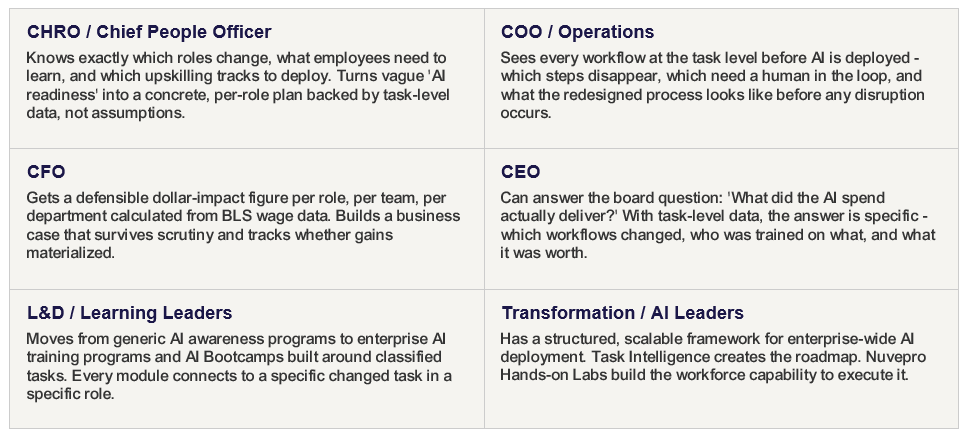
Who uses Task Intelligence and what they get from it
Task Intelligence is the foundation not the finish line
Organizations that get AI transformation right don't start with tools. They start with a question: which specific tasks should change, for which people, in which direction? Task Intelligence is how that question gets answered systematically, at scale, grounded in data from 2.1 million classified tasks across 894 occupations and 81 industries.
It is the foundation of redesigned workflows, targeted enterprise AI training programs, defensible financial outcomes, and the journey toward becoming an agentic organisation, one where humans and AI work alongside each other with clarity about who does what, and why.
Without Task Intelligence, you have AI spend. With Nuvepro’s Task Intelligence Platform, you have an AI-enabled workforce.
START WITH A FREE TASK AUDIT
Enter any job role and see the automate / augment / human-only breakdown with a dollar impact estimate. No signup required.