

Most organizations have already made a decision about AI training. They have licensed a platform. They have built a curriculum. They have enrolled their people in courses about prompt engineering, AI literacy, and tool usage. And then, six months later, they wonder why adoption is sporadic, productivity has not budged, and people are confused about which tasks AI should actually handle.
The problem is not the training quality. The problem is that AI training answers the wrong question. It teaches people what AI is. But it does not teach them which of their specific tasks should change, and how. That is the gap where Task Intelligence comes in. And it is the difference between workforce transformation that sticks and AI initiatives that fizzle.
The AI Training Problem: Teaching About AI Versus Teaching for Changed Work
Most AI training programs follow a standard pattern. They explain how large language models work. They show employees how to write better prompts. They demonstrate use cases in generic scenarios. And they declare the workforce AI-ready.
The assumption underlying this approach is simple: if people understand AI, they will figure out how to apply it to their work. But this assumption breaks down the moment training ends and people return to their actual jobs.
- A financial analyst in Course Module 3 learns how to use AI for data analysis. But which of their 35 daily tasks should actually use AI? They do not know.
- A marketing manager practices prompting techniques in a sandbox. But which workflow steps should be redesigned around AI collaboration?
- A customer service team completes their AI training. But when they return to their tickets, they are still guessing about when to use AI and when to rely on human judgment.
Generic AI training creates awareness. It does not create clarity. And clarity is what actually changes behavior.
Task Intelligence: Starting With Work, Not with Tools
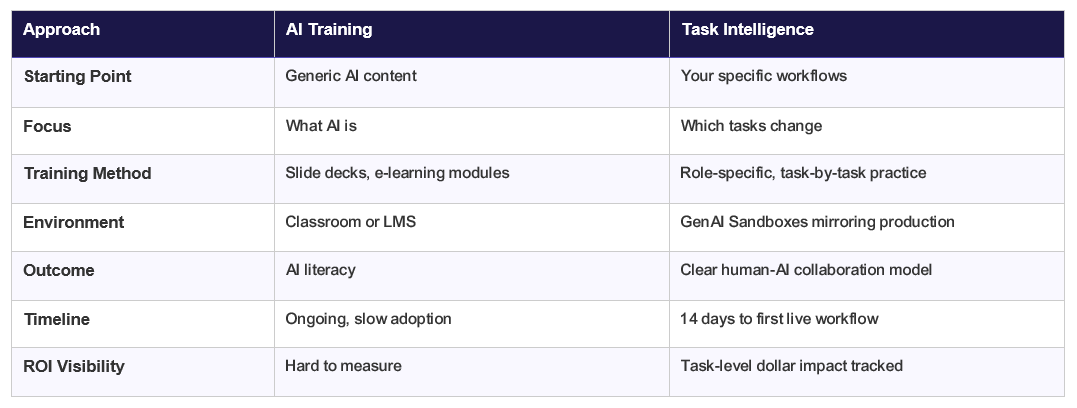
Task Intelligence flips this sequence entirely. Instead of teaching people what AI is and hoping they figure out where to apply it, Task Intelligence first answers a more fundamental question: which specific tasks in this role should AI own, which should be augmented with human-AI collaboration, and which must stay human?
This happens before training ever begins. Using frameworks grounded in 20 years of labor economics research and analysis of 2.1 million tasks across 894 occupations, Nuvepro’s Task Intelligence Platform classifies every task in your key roles. The financial analyst’s 35 tasks are categorized: 10 fully automatable, 16 readies for human-AI augmentation, 9 staying human. Now training has a target.
Then, instead of generic modules, employees complete enterprise AI training programs built directly from that task classification. They train on the 16 tasks that changed in their workflow. They practice in GenAI Sandboxes that mirror their production environment. They build specific human-AI collaboration habits for their role, not abstract AI literacy.
“The organizations getting this right do one thing differently: they map tasks first, deploy tools second, train third. The sequence is everything.”
The Data: What Actually Drives Transformation
The research is decisive. According to Kim's 2026 randomized controlled trial across 515 startups, organizations that invested in Task Intelligence before deploying AI achieved 1.9x revenue improvement. Those that prioritized AI training alone? No significant difference from the control group.
The gap is not marginal. It is transformational. And it holds across other metrics. Organizations using Task Intelligence see 44 percent more AI use cases discovered (because people understand which tasks are eligible), faster time to productivity (because training is targeted), and measurable dollar impact per role (because the changes are specific and trackable).
Harvard and BCG studied 758 consultants using AI. Without Task Intelligence, teams used AI on tasks outside its capability frontier and performed 19 percentage points below their unaided baseline. With it, they achieved 25 percent faster task completion and 40 percent higher output quality. That is the difference between AI that harms productivity and AI that transforms it.
When AI Training Becomes Effective: The Task Intelligence Foundation
This is not an argument against enterprise AI training programs. It is an argument for the right sequence. Effective training happens after task classification, not before it.
Consider two organizations deploying AI on the same workflow. Organization A runs a three-week AI training program covering prompting, use cases, and best practices. Everyone completes it. Adoption rates look good on paper. But six months later, the productivity gains have plateaued because people are not clear on which tasks should actually change.
Organization B spends two weeks mapping Task Intelligence in the workflow. Then they build role-specific training in Nuvepro Hands-on Labs where people practice on the exact tasks that changed in their workflow. Four weeks later, the workflow is live. Adoption is high. Productivity gains are measurable. And people know exactly what changed and why.
The difference is not more training. It is training tied to a clear task-level redesign.
The Role of AI Bootcamps: Scaling Task Intelligence Training
For organizations moving multiple workflows in parallel, AI Bootcamps compress this timeline further. Instead of running sequential training by role or department, AI Bootcamps accelerate the workflow redesign and training delivery across teams simultaneously. Participants learn the same task-driven approach which 30 percent of their work can be automated, which 40 percent needs human-AI collaboration, which 30 percent stays human but in an intensive, cross-functional format.
The result: organizations that might have taken 12 weeks to retrain their workforce after AI deployment can now do it in 4 weeks. But only if that training is built on Task Intelligence foundations. Without that foundation, AI Bootcamps just teach faster what people do not need to know.
Building an Agentic Organization: Task Intelligence First, Tools Second, Training Third
Becoming an agentic organization where AI agents, humans, and hybrid workflows coexist with clarity requires that sequence. Task Intelligence first. It creates the map showing which work goes to agents, which needs human-AI partnership, and which stays human. Tools second. Once the map is clear, the right tools become obvious. Training third. Once people know which tasks changed, training can be targeted and specific.
Organizations that try to reverse this starting with tools, then adding generic AI training, then hoping Task Intelligence will sort itself out end up with organizational confusion, tool sprawl, and frustrated teams. The people who know the work best (your employees) do not have a clear framework for understanding what changed.
The Uncomfortable Truth: Most AI Training Misses the Point
Here is what most enterprise AI training programs do not address: people do not need to understand how transformers work. They do not need to know the difference between fine-tuning and prompt engineering at a technical level. What they need is clarity on their specific changed tasks and practice on those changes in an environment that mirrors reality.
Most AI training courses are built by AI companies that have a financial incentive to make AI seem complex and central to everything. Their business model depends on selling software and certification programs. Task Intelligence does not have that incentive. It simply answers: which work actually changes?
That clarity is worth more than a week of prompting courses.
The Bottom Line: Transformation Requires Task-Level Redesign
Workforce transformation from AI is not primarily a training problem. It is a work-redesign problem. And you cannot redesign work without understanding it at the task level. That is what Task Intelligence provides. Enterprise AI training programs become effective once that redesign is clear.
The organizations that will thrive in the next 18 months are not those that ran the most AI training programs. They are the ones that invested in understanding their work at the task level first, then designed training around that clarity.
If your organization is still primarily focused on AI training as your AI transformation strategy, you are addressing the symptom, not the root cause. Task Intelligence is where transformation actually begins.
START WITH TASK INTELLIGENCE
See how Nuvepro's Task Intelligence Platform maps your workflows, informs your training strategy, and accelerates workforce transformation.