

Enterprises have spent billions on AI tools. And yet most teams walk out of AI training able to recite a framework and walk back into the same workflow, doing the same things, wondering where the productivity went. There is a better way. It starts with understanding the work before touching the tools.
“88% of workforce don’t trust their employer to prepare them for AI. Only 7.5% have received extensive AI training despite daily AI use rising sharply.”
Read those two numbers together and something important becomes clear. Workforces are not resistant to AI. They are using it every day, often with tools their employer never sanctioned, because nobody gave them a structured path. What they don’t trust is their organisation’s ability to prepare them for what comes next.
That distrust is rational. Most enterprise AI training is designed around the tool – what it can do, how to prompt it, what its limitations are. It is not designed around the work – which specific tasks in a specific role are changing, what the new operating model looks like, and how a person proves they can function inside it without a safety net.
Nuvepro’s AI Bootcamp is different in one foundational way: it starts with Task Intelligence, a systematic classification of every task in a real workflow, before anyone opens a GenAI Sandbox. The training is built on what is actually changing in your team’s work, not on AI in the abstract. And it ends with an EASE assessment that validates project-readiness against a real task, not a certificate that says someone attended.
The research is unambiguous. According to a 2025 WalkMe survey, only 7.5 percent of employees have received extensive AI training despite daily AI usage rising sharply across organisations. Over 78 percent admit to using unsanctioned AI tools because they haven’t been adequately guided on how to use the sanctioned ones. And a cross-industry enterprise AI state report found that despite $644 billion spent on AI in 2025, 80 percent of organisations see no material earnings impact.
The tools are not the problem. The training is not even fully the problem. The problem is that nobody mapped the work before doing either of those things.
This is what Nuvepro’s AI Bootcamp and its Task Intelligence platform were built to fix by starting with what a specific team actually does, task by task, classifying how the work changes, and then building the skills around the new reality – hands-on, in production, in 14 days.
“Training that teaches AI exists produces awareness. Training that builds on your real workflow produces a project-ready team.”
The training crisis enterprises aren’t talking about
The numbers on enterprise AI training are striking, and not in a good way. Guild Education surveyed 355 workers and found that 88 percent do not trust their employer to prepare them for AI. This is not a fringe concern - it is the dominant experience of the workforce entering an AI transition.
IBM Race for ROI Study – October 2025 (3,500 senior leaders across EMEA)
66% of UK enterprises are experiencing AI-driven productivity improvements. But only 45% offer company-wide or role-specific AI training. 67% cite internal resistance and cultural barriers as the reason AI pilots stall. The data is clear: adoption without training creates resistance, not results.
The Enterprise AI Training Crisis 2025
88%
of workers don’t trust their employer to prepare them for Al (Guild Education, 2023)
7.5%
of employees received extensive Al training despite daily Al use
(WalkMe, 2025)
80%
see no material earnings impact from Al despite $644B spent in 2025 (Enterprise Al State Report)
234%
ROI when organisations invest properly in Al workforce training (AWS/Enterprise Al Report)
The consequence of this training gap is not just slow adoption. It is active value destruction. A 2025 Stanford and BetterUp study named the phenomenon: “workslop” – AI-generated content that looks polished but lacks substance, requiring downstream rework that erases the time savings. BCG research found that workers managing more than three AI tools simultaneously show 12 percent more fatigue and 19 percent more information overload. When AI is deployed without role-specific, task-grounded training, people don’t just fail to improve. They often get slower.
The fix is not more training. It is training that starts with the work rather than the tool – training that knows exactly which tasks are changing in your specific role before anyone opens a GenAI Sandbox.
What Task Intelligence does before the bootcamp starts
Most enterprise AI training programmes skip a step so fundamental that skipping it guarantees mediocre results: they never ask what work is actually changing.
Task Intelligence is the answer to that question. It is a systematic classification of every task in a role or workflow as automate (AI handles end-to-end), augment (human and AI work together), or human-only (stays with a person). Backed by 1.25 million pre-classified tasks across 81 industries, it turns a vague “our team needs AI training” into a precise map of what is changing and who needs to learn what.
The 30/40/30 Task Split Across 1.25m Classified Tasks
AUTOMATE
30%
Al owns end-to-end | Data checks | Scheduling | Routine reports | Format matching
Agents deployed here first
AUGMENT – HIGHEST VALUE
40%
Human + Al together | Al does 70-80% of the work | Humans provide judgment + sign-off
Where most ROI is captured
30%
HUMAN ONLY
Stays irreducibly human | Empathy Ethics | Negotiation | Relationships | Creative judgment
Protect and invest in this work
When Nuvepro classifies tasks across a workflow, a consistent pattern holds across industries: roughly 30 percent of tasks can be fully automated, 40 percent should be augmented with human-AI collaboration, and 30 percent remain irreducibly human. The 40 percent augmentation bucket is where most enterprise AI value actually comes from — not replacement, but the redesign of how humans and agents share the work.
Harvard Business School & BCG (758 consultants, 2023)
Professionals using AI on tasks inside their capability profile completed 25% more work, 25% faster, with 40% higher output quality. The gains concentrated where AI assisted human judgment – not where it replaced it. This is the Augment bucket in action.
The Task Intelligence platform surfaces these classifications before a single line of training content is written. It means that when your team enters the AI Bootcamp, they are not learning AI in the abstract. They are learning how to operate the specific new model of work that has been designed for their role.
How Nuvepro’s AI Bootcamp actually works
The difference between an enterprise AI training programme that produces project-ready teams and one that produces completions on an LMS is not the content. It is the sequence: you must understand the work before you can train for the new version of it.
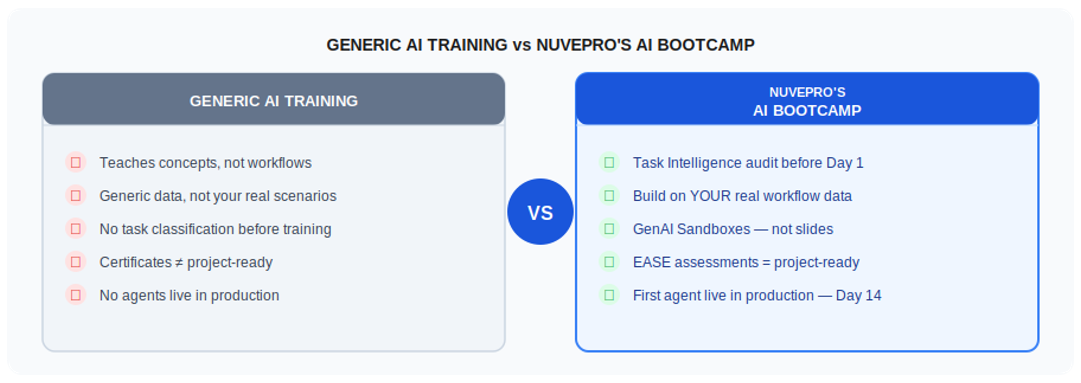
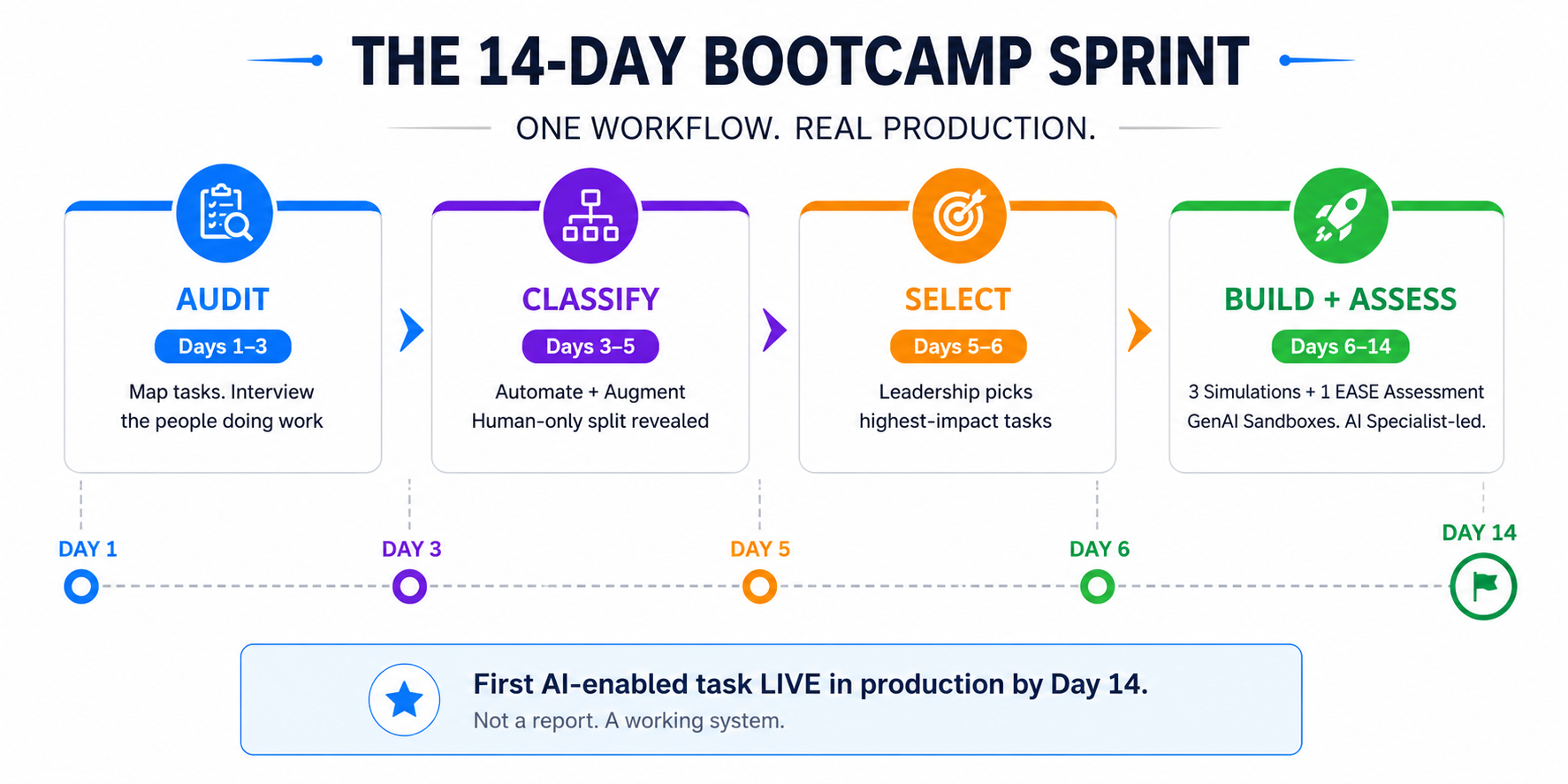
Nuvepro’s AI Bootcamp is structured as a 14-day sprint built around a single real workflow in your organisation. It begins with a Task Intelligence audit – not a generic assessment, but an interview-based classification of every task your team actually does. Leadership reviews the split. Together, the highest-impact tasks are selected. Then the building begins.
The 3 + 1 simulation structure: what your team actually builds
For each task selected in the bootcamp, your team goes through three simulations and one assessment. Each simulation is a four-hour guided exercise built on your real workflow data. These are not slides. They are not case studies. They are your actual workflow, in a GenAI Sandbox, with a Nuvepro AI Specialist alongside your team.
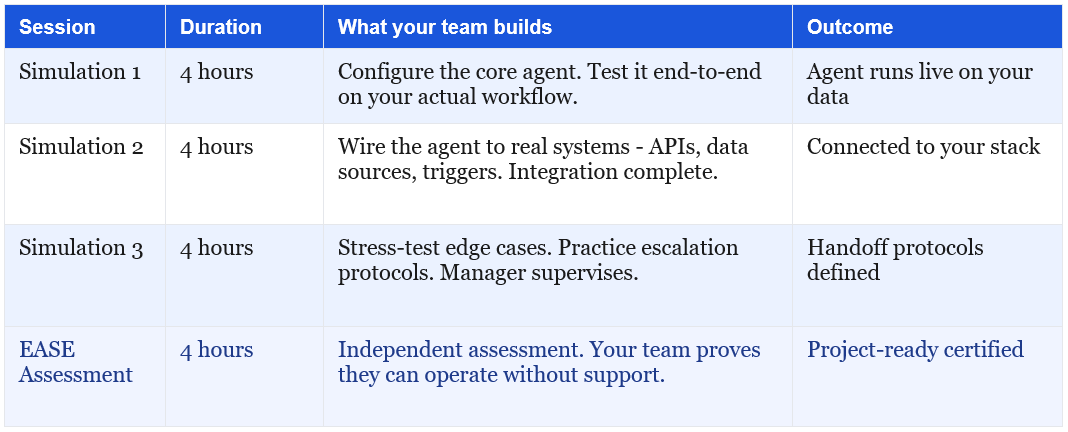
The EASE assessment at the end is not a multiple-choice test. It is an independent scenario – your team operates without the AI Specialist present. Pass means project-ready: they have configured the agent, integrated it with real systems, practised supervising its output, and handled the edge cases. That is the bar. Not a certificate. A demonstrated capability to operate in the new model.
BCG’s 2025 AI at Work report found that organisations investing in reshaping workflows alongside AI upskilling are 1.8x more likely to report better financial results than those that deploy tools without workflow redesign. The AI Bootcamp is built on this principle.
Becoming an agentic organisation: what changes after the bootcamp
The phrase “agentic organisation” gets used loosely. Nuvepro uses it specifically. An agentic organisation is one where the split between human work and agent work has been defined explicitly, handoff protocols have been designed and practised, and people are operating in the new model.
Becoming an agentic organisation is not a transformation programme. It is a series of 14-day sprints, each one adding another workflow to the new model. After the Pilot (one workflow, one task), organisations move to the Sprint (one full workflow, three tasks, up to 15 people). Each sprint compounds: the task classification database grows, the handoff protocols get refined, and the team’s ability to supervise and improve agents accelerates.
14 Days
per workflow sprint from audit to production
3+1
simulations + EASE assessment per task
1.8x
better financial results with workflow redesign (BCG, 2025)
234%
ROI from proper enterprise AI training (AWS data)
The organisations getting there are not the ones that ran the most AI workshops. They are the ones that started with the task map, built the training around the actual work, and measured project-readiness – not completion rates. The World Economic Forum’s 2026 Future of Jobs Report found that organisations investing in workforce development across Vision, Skills, Technology, Process, and Culture are 1.8 times more likely to report better financial outcomes. The AI Bootcamp is how the Skills, Technology, and Process pillars get delivered in one sprint.
What companies that have done this right have in common
The research on enterprise AI training that actually produces results points to several consistent features.
They start with the work, not the tool. A CCSLA case study documented one organisation that delayed its company-wide AI rollout by eight weeks to build a role-differentiated training strategy tied to behavioural outcomes. Eight months after launch, its finance team had cut reporting cycle time by nearly a third. 71 percent of employees reported feeling genuinely capable, not just trained.
They train for the specific tasks that are changing. PwC’s 2025 AI Jobs Barometer found AI-skilled workers command a 56 percent wage premium. That premium is not for generic AI awareness. It is for people who can operate within AI-assisted workflows in their specific domain. Task-grounded enterprise AI training programmes produce this.
They measure project-readiness, not attendance. MIT Sloan found that organisations involving workers in AI implementation decisions are 16 percent more productive than those that impose AI top-down. The EASE assessment used in Nuvepro’s AI Bootcamp is designed on this principle: workers prove they can operate independently before the sprint is declared complete.
They get something live before calling it done. The difference between a bootcamp that changes how workflows and one that produces awareness is a single thing: something in production. The 14-day structure is deliberately tight because the goal is not learning about AI – it is operating in the new model.
The question to take back to your team
If you ran an AI training programme last quarter, here is the question worth asking: what task, in which workflow, is now being done differently because of it? If the answer is unclear, the training was awareness and not transformation.
Task Intelligence makes the question answerable before the training starts. It classifies exactly which tasks are changing, in which roles, and what the new operating model looks like. The AI Bootcamp builds the capability to operate it. And by day 14, you have a task live in production not a report about what might be possible, but a working system on the AI stack you already own.
Becoming an agentic organisation is not one large transformation. It is a sequence of precise, task-level sprints, each one making the next one faster and more reliable. The organisations starting now are not just getting ahead. They are building the organisational muscle that makes every future sprint compound.
Know the exact dollar value of every task you automate before you build anything.
Nuvepro's Task Intelligence audit calculates hours saved and cost impact per role using real wage data giving you a number you can take to leadership before a single agent gets built. The ROI case comes from the task map, not a vendor projection.