
1. The material
180 synthetic case records
A CSV snapshot with case references, owners, supplied delay values and return reasons. No borrower identities or live-system access.
FDE Fellowship
Enterprise cohorts
Shape a Forward Deployed Engineer (FDE) Fellowship cohort around a customer workflow. Practise discovery, build in a bounded business environment and review each engineer’s decisions alongside the working result.
A proposed cohort format. The customer workflow, delivery scope and availability are agreed for your engagement.
Recorded reference practice
A loan operations lead describes delays as a branch follow-through problem. The discovery conversation uncovers a different question: who can actually see which exceptions are waiting, and for how long?
This saved nuvepro.ai exercise connects that conversation to a Python reference build and inspectable output. It uses synthetic records and a simulated stakeholder, not a fellow’s submitted project or a customer deployment.
1. The material
A CSV snapshot with case references, owners, supplied delay values and return reasons. No borrower identities or live-system access.
2. The reference build
Read the CSV, select records using their supplied delay values, then retain each finding’s source case, owner, reason and priority. Inspect the actual implementation below.
3. The saved result
The reference output is available to inspect. A fresh offline replay reproduced those saved bytes exactly. These are exercise counts, not an improvement in customer operations.
The unchanged reference implementation and its public tests were replayed on 25 November 2026. The output matched the saved record byte for byte. This checks the disclosed example; it does not validate learner readiness or a production workflow.
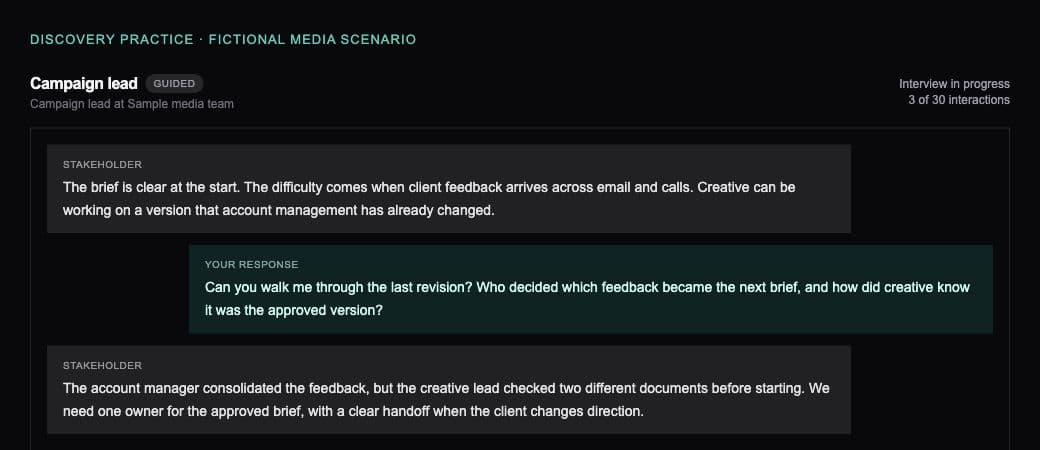
Excerpts from the saved 4 September 2026 practice conversation, with dash punctuation normalized. Both the interviewer and stakeholder are simulated.
Simulated FDE interviewer
Right now, if I asked you 'how many exception cases are open at this moment and how long has each been sitting,' could you or Priya pull that up from a report or dashboard, or would someone have to manually go check?
Simulated operations lead
Priya could give you a working view, but not a clean live ageing report from LendSuite.
Simulated FDE interviewer
When Priya puts together that working view for you, what is she actually doing, does she maintain her own tracker or spreadsheet for the exception queue, or is she calling around to her team and piecing it together on the spot?
Simulated operations lead
Between us, Priya maintains a personal Excel tracker for those exception cases. LendSuite does not have a proper exception queue, so she updates it from the team’s follow-ups and branch responses.
The accepted first scope stayed with exception visibility, branch response and resubmission. A broader loan-system replacement was excluded. The saved brief did not establish business success measures.
The public tests inspect scope inclusion and exclusion, source links, output fields, priority rules, reconciled counts, deterministic output and the command-line entry point. The saved factory record also reports repeat execution and rejected starter, blank and mutated implementations; those historical controls were not rerun for this page.
IN-01057 Priority: high
paystub requires clarification
Recorded owner: deviation desk · Supplied delay: 4.9 days
IN-01014 Priority: high
mismatch received; analyst follow-up required
Recorded owner: underwriting · Supplied delay: 4.7 days
IN-01159 Priority: high
asset statement requires clarification
Recorded owner: underwriting · Supplied delay: 4.6 days
These are original synthetic findings, not new customer records. The full JSON retains the source references and fields.
A passing suite still leaves a question. The automated test review accepted the suite with an advisory: global priority sorting was required by the tests but was not explicitly stated in the technical contract. The record does not show that advisory being resolved. This is model-generated test feedback, not a human panel assessment.
Before accepting that behavior, ask the workflow owner to agree the ordering and make the contract and checks consistent. That is a review decision, not an extra requirement to assume.
This prototype uses supplied delay values. It does not establish live case age, branch response timestamps or working-day correctness, and it does not demonstrate reduced turnaround time, audit acceptance or production authorization.
The cases, reference code and recorded output preserve the original source bytes. The evidence file is a public summary with source hashes, discovery excerpts, replay results and limits. This disclosed reference example includes its answer; unseen assessment material is excluded.
Learn how the work runs, which rules apply, where exceptions arise and who owns each decision.
Question a simulated stakeholder, uncover missing context and agree a bounded problem before choosing the technology.
Build a working solution in a sandbox, check its behavior and defend the choices behind it.
A cohort around your work
Agree what the engineers need to take on. Capture their starting evidence, practise the work and inspect each person’s decisions before deciding what comes next.
Sponsor + workflow owner
Evidence: Customer problem, nominees and boundaries
Each engineer + reviewers
Evidence: Programming, discovery and domain evidence
Engineers + mentors
Evidence: Problem brief, implementation and checks
Each engineer + review panel
Evidence: Individual explanation and unresolved gaps
Sponsor + accountable manager
Evidence: Further practice or a separately reviewed assignment
When a check fails or a reviewer rejects the result: withhold acceptance, repair the work, rerun independent checks, then return for human review. A good team demonstration does not erase an individual gap.
Illustrative assignment preview
Give your cohort a customer problem that requires discovery and engineering together. In this banking illustration, the task is a reviewable loan file, with the credit decision kept in human hands.
Discovery
“We want every loan application to reach the credit officer complete, consistent and checked against policy.” Your first task is to question the lending owner, rather than assume which feature solves it.
Investigation
Where does information go missing? Which income record supports the figure in the file? Which lending-policy version applies? Agree the problem, source records and review responsibility before implementing the workflow.
Build artifact
Bring together a sample application, income documents, bureau record and versioned policy. Link each extracted figure to its source. The output for review contains the assembled file, calculations, missing information and exception route.
Hold and investigate
The income figure in the assembled file does not reconcile to its cited document, and one required document is absent. In this illustration, keep the file held for review, name the gap, correct the extraction and rerun the independent checks. Do not invent the missing evidence.
Human review
“Show me where this figure came from. What did you change after the failed reconciliation? What remains unresolved?” Explain the evidence and the repair. A reviewer can send the work back for correction and another check.
The credit officer approves or declines. The agent never does. Applications outside policy remain flagged for human review.
This is a static illustration of planned work, not a recorded run, passed test or graduate outcome.
Inside the practice
See the conversation, the material engineers work with and the evidence a reviewer would inspect. The examples below distinguish an existing public discovery illustration from proposed banking and sponsor-review layouts.
Public discovery-practice illustration
Illustrative banking workspace
Sample records
Loan-file review packet
Proposed sponsor-review template
Questions asked and assumptions made
Agreed brief, missing facts and decision owners
Programming and tool-use exercise
Source-linked implementation and design explanation
How the person checks an uncertain answer
Failure trace, repair and independent recheck
How the person explains a previous decision
Individual defence, limits and next actions
A lending scenario connects application intake, a document store, bureau records, policy rules and the credit officer’s queue. The cohort builds the relevant parts and shows how they behave together. The design can use a conventional rule or service where that answers the problem; every task does not require an agent.
Collect and structure the application and supporting records. Preserve field provenance, identify missing material and reconcile income and obligations against source documents. Review the resulting file, not only the text an LLM returns.
Build a policy assistant over the agreed lending material. Test answer correctness and supporting passages, policy exceptions and unsupported questions. Agree who maintains policy versions and who decides an ambiguous interpretation.
Define approved reads, writes and routing actions. Implement integrations in the practice environment, with permission boundaries and human approval where required. Inspect refused actions, unavailable services and attempts to act beyond the scenario’s authority.
Retain traces that connect an incorrect outcome to its inputs and actions. Exercise missing documents, service failures, prompt injection and leakage risks. Rerun independent checks after repair and record the remaining untested conditions.
Review the decisions behind the demonstration. The proposed evidence pack brings the team’s output, each person’s contribution and unresolved gaps into one discussion with your nominated reviewers.
The request in the stakeholder’s words, the problem agreed for the exercise and the assumptions still open.
Check whether the cohort understood the customer.
The inputs, decisions, exceptions and current sequence, with baseline cases and the checks agreed before building.
Inspect the basis for a comparison.
The document pipeline, policy assistant and controlled tools connected in the practice environment.
Review the build and each engineer’s contribution.
Baseline and held-back cases, failed checks, investigation, repairs and reruns, tied to the version and environment.
See what was exercised and what remains unproven.
A recommendation, the limits of the result and outstanding questions, each with an owner and next action.
Decide what further preparation or review is needed.
Human assessment, agent evaluation and acceptance of an operating workflow are separate decisions. Practice evidence covers the conditions exercised; customer rollout requires its own review and authorization.
Brings the workflow, rules and awkward exceptions; challenges whether the proposed result answers the problem.
Challenges the design, integration choices, security, reliability and failure handling.
Helps learners work through the build, investigate failures and inspect the checks.
Coaching adds the customer-facing dimension: asking difficult questions, challenging a request respectfully and keeping judgement under pressure. Confirm who covers each role and when reviewers are available. One practitioner may cover more than one role; domain and engineering scrutiny still need to be explicit.
People behind the practice
Bring customer engagement and judgement into the engineering work. These practitioners bring experience in leadership, delivery and AI-enabled engineering. Cohort roles, practitioner involvement and session schedules are agreed for your engagement.
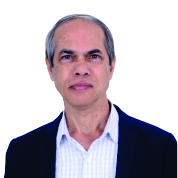
Leadership and customer engagement
Leadership coach and strategic consulting practice lead. Previously Senior Vice President and Global Head of Business Excellence at Mindtree, with earlier leadership experience at Motorola.
Relevant to the Fellowship
Engaging stakeholders, asking better questions and exercising judgement under pressure.

Technology and business judgement
Leadership transformation coach with R&D and new-product development experience across automotive, industrial and aerospace work. Holds a PhD from the Indian Institute of Science.
Relevant to the Fellowship
Connecting engineering choices to the customer’s business problem and explaining the trade-offs.

Engineering and delivery leadership
Practice lead for organizational excellence, leadership, knowledge management and technology adoption. Previously led the Engineering Excellence Group at HCL Technologies.
Relevant to the Fellowship
Questioning delivery decisions, working across stakeholders and keeping operating responsibilities explicit.

AI-enabled engineering
Software engineer with more than three decades of hands-on experience. His work covers system design, problem decomposition and applying generative AI to engineering reasoning and implementation.
Relevant to the Fellowship
Reviewing architecture, explaining implementation choices and using AI with engineering discipline.
Profile images and background information: PM Power Consulting’s official expert profiles. Contribution areas describe their relevance to the proposed Fellowship; practitioner involvement is agreed for each cohort.
Give your fellows a place to compare customer problems, challenge each other’s approaches and carry learning into the next cohort. The proposed community sits inside your organisation and can build on the community you already run.
Discuss discovery conversations, compare architecture choices and ask a fellow to challenge your assumptions. Share the reasoning and the failed attempts, as well as the demo.
Exchange approved, anonymised cases inside your organisation. Discuss what worked, what needed repair and what the next cohort could learn from it.
The community model includes practitioner conversations, fresh scenarios and follow-up case discussions, so fellows can revisit decisions as their experience grows.
Agree community ownership, participation, practitioner involvement and follow-up cadence when scoping the cohort.
Nominate engineers for the client responsibilities they need to take on. A pre-assessment of programming, AI-tool familiarity, domain knowledge and customer conversations establishes each person’s starting evidence. Use that record to agree targeted practice, rather than repeat capability already demonstrated.
Is the gap in stakeholder discovery, workflow analysis, AI engineering or leading a client-facing build? Name the expected decisions and the person who will review the result.
Discuss Foundation, Intermediate and Pro as proposed paths. Keep each person’s discovery exercise, technical work and identified gaps as the starting record. Select using this evidence and the work ahead, rather than a job title alone.
Agree the workflow owner, input records, systems, rules, exceptions and output. Mark which details are confirmed and which need investigation. Set the pass criteria before the build.
Use masked or synthetic scenario data and agreed access. Customer-specific records, licences, environments and review time need named owners in the delivery scope.
The proposed practice sequence keeps the customer problem in view throughout the build. Each stage leaves something a reviewer can inspect.
Practise the discovery conversation. Ask what the workflow owner needs, challenge assumptions and agree what to solve.
Output: An agreed problem statement for the exercise
Repeat the conversation when an answer reveals a gap. Separate the requested feature from the underlying work problem, identify who can agree the brief and keep unsupported assumptions visible.
Do the work by hand. Map the records, systems, rules and exceptions, then establish a baseline and agree the checks.
Output: A workflow brief, baseline and pass criteria
Work through fixed cases manually, including awkward exceptions. Record the current sequence and timing, the evidence each decision uses and which uncertainties need the workflow owner’s answer.
Choose an approach that fits the problem. Build with the scenario’s data and tools in a bounded business environment.
Output: A working workflow in the practice environment
Implement the document pipeline, policy assistant and controlled tools the scenario calls for. Explain the architecture and integration boundaries. Use the simplest technique that satisfies the agreed criteria.
Compare with the baseline. Test missing information, failures and actions the agent must refuse. Repair failed checks and run them again before review.
Output: A verification record, including failures and limits
Inspect both the output and the actions taken. Exercise cases held back from the build, review failure traces and compare timing only when correctness checks pass. Record exactly what a rerun establishes.
Demonstrate the capstone to reviewers playing the customer, technology and risk roles. Explain the evidence, trade-offs and remaining gaps.
Output: A defended recommendation and team capstone
Present the request, problem, agreements and evidence. Expect questions about permissions, failure and limits. A reviewer’s challenge can send the work back for correction before another demonstration.
A proposed weighting is discovery 20%, workflow analysis 15%, build 30%, verification 20% and defence 15%. These are reference weights to agree for the engagement, not a published certification standard. Required safety and correctness checks remain gates; a high aggregate score cannot compensate for unauthorized actions.
Discovery combines simulator feedback with domain review of the problem statement. Workflow review inspects the map, reproducible baseline and agreed criteria. Automated checks inspect business-system outcomes; an architect and mentor review design judgement and whether people can explain their own work.
Verification compares the same baseline cases and separately held-back cases. Record the version, environment, timing and failures. The defence tests the distinction between request, agreement, evidence, acceptance and unknowns, with an owner and next step for every unresolved gap.
Agree how disputed judgements are reviewed before the cohort. A learner can point to the relevant artifact or trace; the nominated domain or architecture reviewer revisits the evidence and records the reasoning. Missing evidence remains unresolved. Where a gap is confirmed, assign targeted practice and a further review rather than claim readiness from an aggregate score.
The proposed reference structure is ten weeks at 12 hours a week, split between instructor-led sessions and self-paced work. Agree scheduling, protected participation time and delivery regions with the sponsor. This is a planning reference; it does not confirm availability or guarantee that every workflow fits the same duration.
A weekly gate reviews the artifact due, the checks attempted, unresolved issues and the next action. Domain review establishes the problem and baseline. Architecture review challenges the build before more work depends on it. Failed checks return for repair and rerun, rather than being averaged away by a good presentation.
The capstone starts as the customer scenario on day one and is developed across the stages. A panel playing the workflow owner, technology and risk reviews the final demonstration. Compare each person’s starting evidence with their own contributions and exit defence. Report demonstrated responsibilities, remaining gaps and the next practice or review needed; do not infer individual competence from a team result.
A sponsor, cohort nominations, protected practice time and access to workflow expertise. Agree the scenario, data permissions, policies, acceptance criteria and review availability. Name the owner of unresolved domain questions and the owner of any future operating decision.
The practice environment, simulations, sandbox access, mentor and expert involvement, review gates and evidence pack. Transformation coaching can address customer engagement and judgement. Confirm the practitioners, session format, licences and support in the engagement rather than assume a named faculty or continuing service.
The evidence identifies demonstrated responsibilities and remaining gaps. A live deployment needs its own data, security, integration, operational ownership and customer acceptance. The proposed internal fellows community supports peer exchange and follow-up learning. Agree its ownership, cadence and practitioner involvement when scoping the cohort; it does not imply production or support responsibility.
The sponsor’s first decision
Use the first discussion to agree a cohort scope, the people who review it and the evidence your managers need. Make the time and ownership visible before confirming delivery.
Planning reference: ten weeks at 12 hours a week. This proposed learner commitment combines guided and independent work. Agree their split and the sponsor’s domain and architecture review effort; no fixed reviewer-hour entitlement is implied.
Scope the cohort and review planBring your team’s programming and AI-tool experience, customer-facing responsibilities and target workflow. Together we can discuss prerequisite preparation, the practice environment, mentor involvement and the evidence you need.
Enquire about your cohort